Shoreline erosion on private waterfront properties is rarely a single dramatic event. In most cases, it accumulates over many seasons — a few centimetres of bank lost each spring, exposed roots appearing after summer storms, gradual narrowing of a lawn or path near the water. By the time the loss is visually obvious, the underlying processes have often been operating for years.
This article describes how erosion occurs on small private water bodies in Canada, what site features make a shoreline more or less vulnerable, and what property owners can do — often without heavy equipment — to slow or prevent ongoing loss.

Surface erosion caused by water flow. Image: Wikimedia Commons (CC BY-SA).
Primary erosion forces on small water bodies
Wave action
Even on small ponds with limited fetch, wind-driven waves erode the shoreline over time. The energy of a wave is concentrated at the point where it meets the bank. If the bank is composed of fine soil with no protective vegetation or armour, each wave impact dislodges a small amount of material. On an exposed southwest-facing shore, where prevailing westerly winds build the largest fetch, this process is more pronounced.
Ice push and ice scour
In Canadian climates, shoreline ice is one of the most underestimated erosion forces. When a lake or pond freezes, the ice sheet expands as temperatures drop further. This expansion pushes horizontally against the shore, displacing bank material and uprooting vegetation. In spring, moving ice rafts can scour the shore face and deposit debris above the normal high-water mark. Shorelines with established woody shrubs (willow, alder) are more resistant to ice push than bare soil banks.
Runoff and surface wash
Precipitation landing on impervious surfaces — rooftops, driveways, compacted lawns — flows to the lowest point, which is often the shoreline. Concentrated runoff cuts channels into bank soil and carries sediment into the water body, contributing simultaneously to bank loss and water quality degradation. Slowing runoff before it reaches the bank through vegetated buffers and infiltration areas reduces both problems.
Freeze-thaw cycling in bank soil
Soil at the bank face undergoes repeated freezing and thawing through autumn, winter, and spring. Water in the soil pore spaces expands when it freezes, disaggregating the soil structure. The loosened particles are then available for transport by the next rain or wave event. Clay-rich soils are particularly susceptible to this process.
Assessing shoreline vulnerability
Not all sections of a private shoreline erode at the same rate. Features that increase vulnerability include:
- Steep banks (greater than approximately 30 degrees from horizontal) — gravity adds to the downslope pull on soil particles.
- Fine-textured soils (silt or clay) — these are more easily detached by water than coarser sands and gravels.
- Absence of vegetation at the water's edge — roots bind soil and dissipate wave energy; their removal leaves soil directly exposed.
- Long fetch — a greater expanse of open water means larger waves reaching the shore.
- Previous clearing or grading — disturbed soils have less structural integrity than undisturbed soil profiles.
Prevention measures by erosion type
Addressing wave scour at the toe
Placing a buffer of angular rock (riprap) or large woody debris along the base of the bank is the most direct approach to toe erosion. Woody debris — large logs and root masses — is increasingly recognized as an ecologically preferable alternative to stone on forested lakeshores, as it provides fish habitat and allows natural sediment processes to continue adjacent to the protected area.
Emergent aquatic plants — cattails, bulrushes, sedges — planted in shallow water immediately in front of the bank face also attenuate wave energy before it reaches the bank. A well-established stand of native emergents reduces the erosive power of incoming waves across its width.

Emergent and marginal plants at a pond edge. A diverse native planting attenuates wave energy and binds bank soil. Image: Wikimedia Commons.
Managing surface runoff
Redirecting concentrated runoff away from the bank edge is one of the most cost-effective prevention measures available. Practical steps include:
- Establishing a vegetated buffer strip of at least 10 to 15 metres between mown lawn and the water's edge. A buffer of native grasses, sedges, and shrubs slows runoff, allows it to infiltrate, and filters suspended sediment.
- Redirecting eavestroughs and downspouts away from the shoreline and toward infiltration areas further from the water.
- Avoiding grading that directs drainage toward the bank face.
Protecting against freeze-thaw erosion
Dense vegetation — particularly the mat of roots and organic matter created by established sedges and rushes — insulates bank soil from extreme freeze-thaw cycling. Where banks are bare, applying a layer of erosion control blanket (jute mesh or coir) over a seeded slope can protect surface soil through the first winter after planting.
Reducing ice push damage
Woody shrubs rooted at the shoreline — particularly willows and alders — offer the most practical resistance to ice push on small private properties. Their stems deflect and partially absorb ice pressure; their roots hold the bank below the surface regardless of surface disturbance above. On properties with a history of severe ice damage, placing large angular boulders at strategic points along the bank face provides additional resistance.
Vegetation re-establishment after erosion
If a section of bank has already been eroded, re-establishing vegetation is usually the first step. Bare, eroding banks can often be stabilized in one or two growing seasons with a combination of coir log toe protection, live willow stakes, and a native seed mix applied to the slope face. The Ontario Shoreline Naturalization guide provides specific species recommendations for eastern Canadian conditions; similar resources exist through provincial conservation authorities in British Columbia, Manitoba, and Quebec.
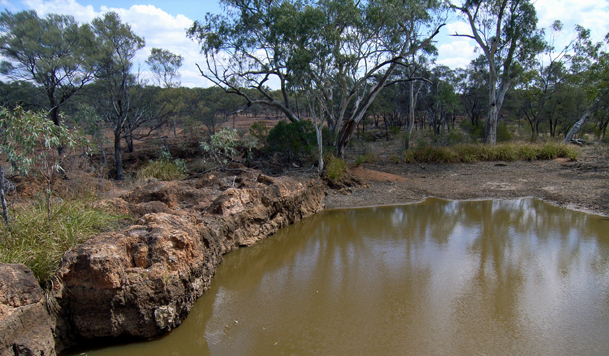
Established riparian vegetation provides natural bank protection. Image: Wikimedia Commons (CC BY-SA).
Permits and regulatory context
In Canada, physical work on or near a water body — including placing riprap, installing erosion control measures, or removing aquatic vegetation — may require authorization. Requirements vary by province and by the nature and scale of work. Property owners planning shoreline work should contact their provincial Ministry of Natural Resources or equivalent body, and review Fisheries and Oceans Canada guidance on works near water, before beginning.